What is Deep Learning?
Deep learning is composed of multiple processing layers that learn hierarchical representations of data. It discovers complex structures in very large datasets by using the backpropagation algorithm. These deep convolutional networks have brought breakthroughs in processing images, videos, speech, and other complex data types.
Why Do We Need Deep Learning?
Classical machine learning techniques were insufficient for processing natural data in their raw form. This limitation led to the introduction of Representation Learning - a set of methods that allows machines to be fed raw data and automatically discover the representations needed for detection or classification.
This approach consists of simple but non-linear modules that transform representations from one level into slightly more abstract representations at higher levels. For example, an image comes as an array of pixel values. The learned features in the first layer typically represent the presence or absence of edges at particular orientations and locations. The second layer detects motifs by spotting specific arrangements of edges, regardless of small variations in edge positions. The third layer assembles motifs into larger combinations corresponding to parts of familiar objects, and subsequent layers detect complete objects as combinations of these parts.
The key aspect of deep learning is that these hierarchical features are not designed by human engineers - they are learned from data using general-purpose learning procedures.
Deep Learning in Supervised Learning
Classification and Optimization
In classification tasks - such as categorizing an image as a house, car, or animal - we compute an objective function that measures the error between output scores and desired patterns. The machine modifies parameters (the weight vector) using Stochastic Gradient Descent (SGD). It's called "stochastic" because each small batch of examples provides a noisy estimate of the average gradient over all examples, giving us information about whether the error would increase or decrease if weights were adjusted by tiny amounts.
Non-linear Activation Functions
Deep learning methods rely heavily on non-linear functions. The most commonly used activation function in neural networks is the Rectified Linear Unit (ReLU), though conventional sigmoid functions like hyperbolic tangent and logistic functions are also used. In recent years, ReLU has become preferred because it enables much faster training in networks with many layers, allowing the training of deep supervised networks without requiring unsupervised pre-training.
Why Gradient Descent Works
A major theoretical concern with gradient descent is that it might get trapped in poor local minima. However, in practice with large networks, this is rarely problematic. Regardless of initial conditions, the system nearly always reaches solutions of very similar quality. Local minima are generally not a serious issue in deep learning.
Deep Feedforward Networks and Pre-training
Researchers discovered that by 'pre-training' several layers using reconstruction objectives, the weights of deep networks could be initialized to sensible values. A final layer could then be added and the entire system fine-tuned using backpropagation. This pre-training approach allowed researchers to train networks 10-20 times faster than previous methods.
Unsupervised Learning
Unsupervised learning pre-training works particularly well for small datasets by preventing overfitting, leading to better generalization when labeled examples are scarce. It's also valuable in transfer learning scenarios where abundant examples exist for 'source' tasks but few for 'target' tasks.
Convolutional Neural Networks (CNNs)
CNNs are specifically designed to process data in the form of multiple arrays, such as images composed of 2D pixel arrays. Four key ideas underpin CNNs: local connections, shared weights, pooling, and the use of many layers.
- Convolutional layers detect local features from previous layers
- Pooling layers merge semantically similar features, with typical pooling units computing the maximum of local patches in feature maps
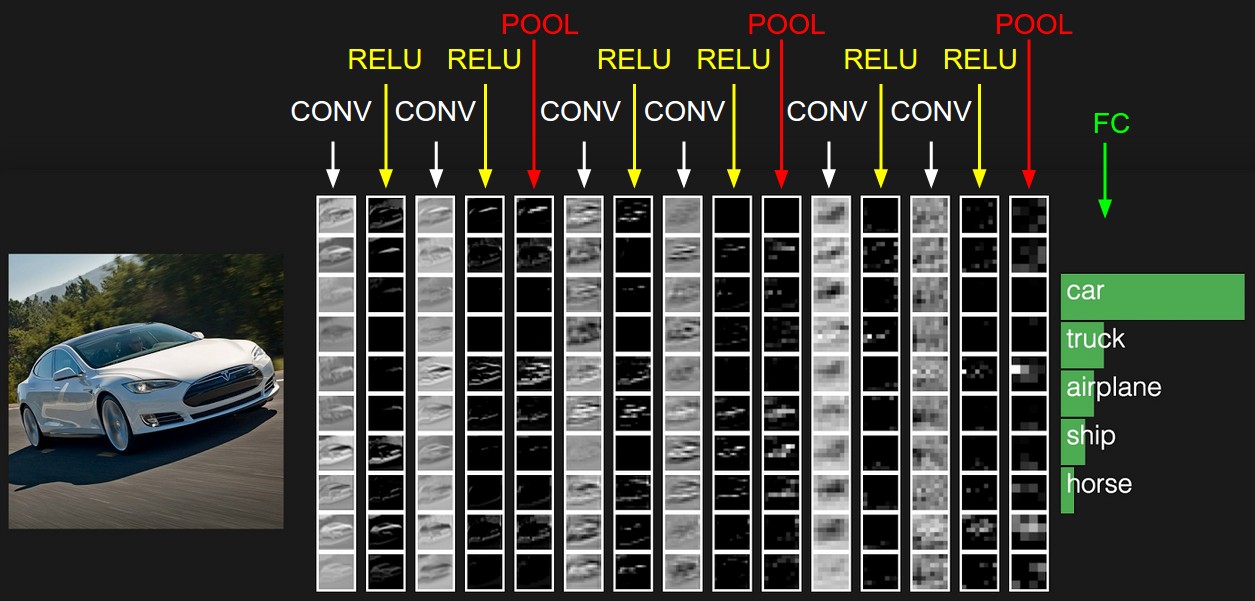
Figure 1: CNN architecture showing the hierarchical feature learning process - from raw pixels through convolutional layers detecting edges, to pooling layers merging features, ultimately building complex object representations layer by layer.
Historical Context and Applications
CNNs have roots in the neocognitron architecture, though early versions lacked end-to-end supervised learning algorithms like backpropagation. Early 1D CNNs called time-delay neural networks were used for phoneme and word recognition.
Microsoft later deployed ConvNet-based optical character recognition and handwriting recognition systems. In the early 1990s, CNNs were experimented with for object detection in natural images, including faces and hands.
The ImageNet competition in 2012 revolutionized computer vision and machine learning. Deep convolutional networks applied to approximately one million web images across 1,000 classes achieved remarkable results, nearly halving the error rates of competing approaches. This success stemmed from efficient GPU usage, ReLU activations, dropout regularization, and data augmentation techniques.
Biological Inspiration
Interestingly, when ConvNet models and monkeys are shown identical pictures, the activations of high-level units in ConvNets explain half the variance of 160 randomly selected neurons in the monkey's inferotemporal cortex, suggesting biological plausibility.
Recurrent Neural Networks (RNNs): Processing Sequential Data
Understanding RNN Architecture
RNNs are designed to handle sequential data by processing input sequences one element at a time. They maintain a 'state vector' in their hidden units that implicitly contains information about the history of all past elements in the sequence. This makes them particularly powerful for tasks involving temporal dependencies or variable-length sequences.
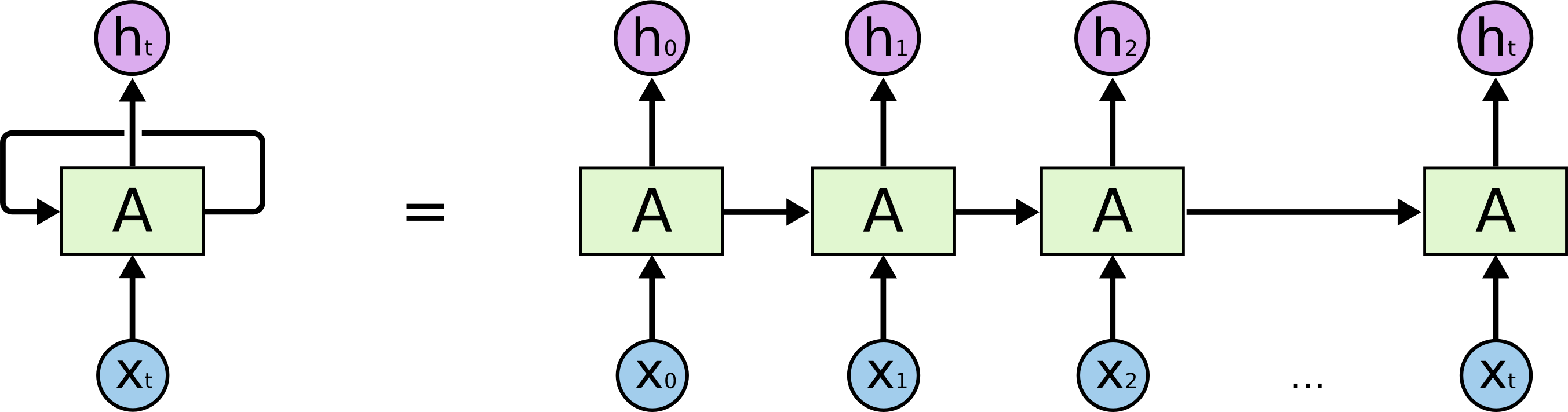
Figure 2: RNN processing sequential data with hidden state memory. The network maintains information from previous time steps, enabling it to understand context and temporal patterns in sequences like text or speech.
Word Representations and Language Modeling
In language processing, each word is presented to the network as a one-hot vector (one component equals 1, all others are 0). In the first layer, each word creates a unique pattern of activations, forming word vectors. For language modeling, subsequent layers learn to convert input word vectors into output word vectors for predicting the next word, enabling probability calculations for any vocabulary word appearing next.
Distributed Representations
Learning word vectors works exceptionally well when word sequences come from large text corpora, even when individual patterns are unreliable. When trained to predict the next word in news stories, learned word vectors for semantically similar words (like "Tuesday" and "Wednesday," or "Sweden" and "Norway") become very similar. These distributed representations have elements that aren't mutually exclusive, with many configurations corresponding to variations in observed data.
These automatically discovered word vectors, composed of learned rather than pre-determined features, are now widely used in natural language applications. They enable neural networks to perform fast, intuitive inference underlying effortless commonsense reasoning.
Advantages Over Traditional N-gram Models
Before neural language models, statistical language modeling relied on counting frequencies of short symbol sequences (N-grams) of length up to . The number of possible N-grams scales as (where is vocabulary size), requiring enormous training corpora for contexts beyond a few words. N-grams treat words as atomic units, preventing generalization across semantically related word sequences. Neural language models overcome this by associating words with real-valued feature vectors, placing semantically related words close together in vector space.
Training Challenges
Despite their power as dynamic systems, RNNs face significant training challenges. Backpropagated gradients either grow or shrink at each time step, typically exploding or vanishing over many time steps, making long-term dependency learning difficult.
Beyond Traditional RNNs: Advanced Architectures
Long Short-Term Memory (LSTM)
The Long Short-Term Memory (LSTM) network addresses RNN limitations using special hidden units designed to remember inputs for extended periods. The key innovation is a memory cell acting like an accumulator or gated leaky neuron. It maintains a self-connection with weight 1, copying its real-valued state and accumulating external signals. This self-connection is multiplicatively gated by another unit that learns when to clear memory content.
LSTM networks have proven more effective than conventional RNNs, especially in multi-layer configurations. They enable complete speech recognition systems processing from acoustics to character sequences and are currently used in encoder-decoder networks for machine translation.
Memory-Augmented Networks
Advanced architectures include Neural Turing Machines, where networks are augmented with tape-like memory for reading and writing, and memory networks with associative memory components. These systems handle tasks normally requiring reasoning and symbol manipulation, with Neural Turing Machines capable of learning algorithms.
Looking Forward: The Transformer Revolution (Post-2015 Perspective)
While this seminal 2015 paper laid crucial groundwork for modern deep learning, it's worth noting that the field experienced another paradigm shift with the introduction of Transformer architectures in 2017 ("Attention Is All You Need" by Vaswani et al.).
Transformers addressed many RNN limitations mentioned in this paper through:
- Self-attention mechanisms that capture long-range dependencies without sequential processing
- Parallel computation enabling much faster training than RNNs
- Better gradient flow eliminating vanishing gradient problems
- Scalability to massive datasets and model sizes
The Transformer architecture has since become the foundation for breakthrough models like BERT, GPT, and modern large language models, representing the next evolutionary step beyond the RNN-based approaches discussed in the original paper.
Future Directions
The authors concluded that major progress in artificial intelligence will emerge from systems combining representation learning with complex reasoning. While deep learning and simple reasoning have long been used for speech and handwriting recognition, new paradigms are needed to replace rule-based symbolic manipulation with operations on large vectors - a vision that continues driving AI research today.
This review captures the essence of one of the most influential papers in modern AI, providing foundational understanding for anyone entering the field of deep learning.